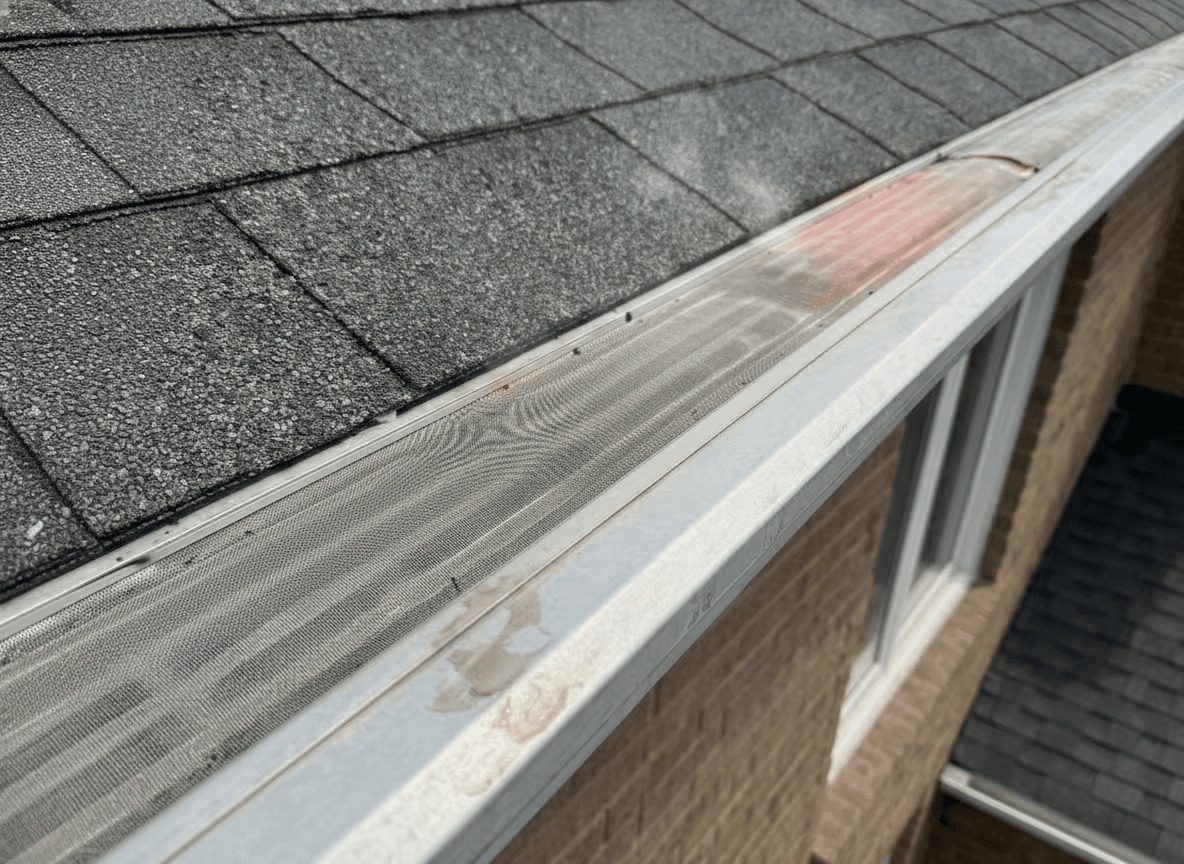
An honest 2026 head-to-head of two fundamentally different gutter guard technologies — EavesArmour micro-mesh and Gutter Helmet reverse-curve — so you can decide which approach suits your Ontario home.
Disclosure: This page is published by EavesArmour. We have kept all competitor claims factual and based on publicly published product information, marketing materials, and our own experience quoting in Ontario. Product specifications, warranty terms, and availability can change — confirm current details directly with Gutter Helmet dealers in your area during a free in-home estimate. If you spot something inaccurate, please contact us and we will correct it.
The key differences that determine which system is right for your home and Ontario's climate.
| Feature | EavesArmour | Gutter Helmet |
|---|---|---|
| Guard technology | Stainless steel micro-mesh on aluminum frame | Solid ribbed reverse-curve cover |
| Water entry method | Filtered through fine mesh (all rain rates) | Surface tension over curved nose into slot |
| Debris blocking | All debris: pine needles, shingle grit, pollen, maple keys | Large debris; small particles can enter through slot |
| Heavy-rain performance | Full mesh area handles high-intensity rain | May overshoot gutters in extreme downpours |
| Heated / ice dam option | Yes — EavesArmour ICE (integrated) | Yes — Helmet Heat (add-on cable) |
| Warranty | Lifetime transferable | Lifetime (through authorized dealers) |
| Company origin | Canadian-headquartered | US-based (Gibraltar Industries) |
| Ontario service | Local installation crews across southern Ontario | Through authorized dealer network |
| Typical Ontario price | $15–$30 / linear foot | Request quotes from local authorized dealers |
EavesArmour and Gutter Helmet use completely different engineering approaches. Understanding both helps you pick the right one for your roof.
The stainless steel micro-mesh from EavesArmour sits across the entire top of the gutter. Rainwater passes freely through thousands of tiny openings in the mesh and into the gutter below. Leaves, pine needles, shingle granules, pollen, and maple keys land on the surface and either blow off in the wind or wash off during the next rain.
Because the full gutter width is open to water, micro-mesh handles high rainfall rates without overflowing. Periodic rinsing with a garden hose — typically once a year — keeps the mesh clear of fine organic buildup. The EavesArmour Gutter Protection system is built on an extruded, anodized aluminum frame designed to match standard Ontario eavestrough profiles.
Gutter Helmet is a solid ribbed aluminum cover that extends over the top of the gutter with a nose-forward curve. It relies on the physics of surface tension: rainwater clings to the curved surface, follows the nose around, and drips through a narrow slot into the gutter. Leaves and large debris land on the ribbed surface and slide off the front edge onto the ground below.
Because the cover is solid and low-profile, nothing is visible from street level. The tradeoff is that the narrow slot can admit small debris in some installations, and in extreme rainfall the water sheet may detach from the nose and overshoot the gutter opening rather than following the curve in.
There is no universal winner. The right system depends on your roof, your trees, and what matters most to you.
Visit gutterhelmet.com for current product details, pricing, and dealer locations.
Southern Ontario regularly sees intense spring rain events. During a heavy downpour — 25+ mm per hour — micro-mesh guards like EavesArmour handle the full volume because the entire mesh surface is open to water flow. The gutter fills quickly and drains continuously without overshooting.
Reverse-curve solid covers depend on a narrower water entry slot and the physics of surface tension. In extreme rain, water can exceed the capacity of this system to follow the curve, detach from the nose, and fall past the gutter opening — depositing water right next to your foundation. This is a known characteristic of the reverse-curve design and shows up in independent home inspector reviews.
If you live in Hamilton, Burlington, or the Niagara Peninsula — regions with higher spring rainfall intensity — this is a material factor. See our gutter guard types comparison for a broader look at how different technologies perform under Ontario conditions.
The freeze-thaw cycle in Ontario is the most demanding condition any gutter guard faces. Snow melt drains toward the eaves, refreezes overnight, and over time forces its way under shingles. A clean, unobstructed gutter is the first line of defence — and that is where both EavesArmour and Gutter Helmet help by keeping debris out.
For homes with a history of ice dams — especially north-facing roofs, shaded eaves, or low-slope sections — a standard guard of any type is not enough. Both companies offer heated options. EavesArmour offers EavesArmour ICE — a fully integrated heated micro-mesh system where the self-regulating heat cable is built into the guard design from the start. Gutter Helmet offers Helmet Heat, a heat cable add-on that runs alongside the cover.
Both heated options address ice dam risk; the difference is integration and design intent. For peak ice dam season — active now through early spring — ask any installer specifically which heated version they are proposing. See our heated gutter guards Ontario guide for a full breakdown of options available in the province.
EavesArmour installations in 2026 generally run $15–$30 per linear foot in Ontario, depending on linear footage, roof pitch, existing gutter condition, and whether a heated upgrade is included. For a typical southern Ontario semi-detached — roughly 100–130 linear feet — that puts a standard project in the $1,500–$3,900 range before any repairs.
Gutter Helmet pricing varies by authorized dealer and is not publicly listed. As a name-brand solid-cover system with a long market history, it typically prices at a premium compared to independent installers. We recommend collecting a Gutter Helmet quote from a local dealer and comparing it line for line with an EavesArmour estimate — same linear footage, same downspouts, same any-required-repairs — to see the actual difference for your specific home. See our Ontario 2026 gutter guard cost guide for current per-foot benchmarks across the province.
If you have already received a Gutter Helmet quote, bring it to your EavesArmour estimate. We will give you a line-by-line comparison so you can decide which delivers better value for your home.
EavesArmour operates with local installation crews across southern Ontario, including Hamilton, Burlington, Oakville, Mississauga, Toronto, Kitchener, Cambridge, and throughout the GTA and KWC region. Gutter Helmet is available through its authorized dealer network; availability in specific Ontario markets varies.
Our blog post Gutter Helmet vs EavesArmour in Ontario dives deeper into real-world comparisons from Ontario homeowners who have been quoted on both systems.
The fundamental difference is the product technology. EavesArmour uses a stainless steel micro-mesh mounted on an anodized aluminum frame. Rainwater filters through the mesh while debris — including shingle grit, pine needles, maple keys, and pollen — stays on top and either blows off or rinses away. Gutter Helmet is a solid ribbed cover that uses the reverse-curve principle: water clings to the curved nose of the cover and drops into the gutter through a slot, while debris slides off the front edge. Both approaches work, but each has tradeoffs for Ontario's specific weather patterns, particularly heavy spring rains and freeze-thaw winters.
Gutter Helmet offers a heated add-on called Helmet Heat that runs a heat cable along the gutter and guard to prevent ice dam formation. Without the heated option, any gutter guard — including solid covers — can contribute to ice damming when snow melt refreezes in the gutter. EavesArmour offers EavesArmour ICE, its own integrated heated micro-mesh system purpose-built for Ontario's freeze-thaw cycles. For Ontario homes with north-facing roofs, shaded eaves, or a history of ice dams, we recommend asking any company specifically about their heated option before committing. Neither standard (non-heated) system is a complete solution for severe ice dam conditions.
Micro-mesh systems like EavesArmour have an advantage in heavy rain. Because the entire mesh surface area lets water through, they can handle virtually any rain rate. Reverse-curve and solid-cover systems — including Gutter Helmet — rely on water surface tension to guide flow into the gutter slot. In extreme downpours (which are common in southern Ontario during spring storms), the water sheet can detach from the nose and overshoot the gutter opening entirely, sending rain straight past the gutter. This phenomenon — sometimes called the 'waterfall effect' — is a known limitation of solid-cover designs in high-intensity rain. If your home is in a high-rainfall area or has sections of roof with long water runs, this is worth factoring into your decision.
EavesArmour installations typically run $15–$30 per linear foot in Ontario, depending on linear footage, roof pitch, existing gutter condition, and whether a heated upgrade is included. Gutter Helmet pricing should be obtained directly from authorized dealers in your area, as it varies by installer. As a general rule, name-brand solid-cover systems with long market histories tend to price at or above premium micro-mesh options. The best approach is to get both quotes in writing with line-item detail — linear footage, downspouts, any required gutter repairs — so you can compare like for like.
Micro-mesh guards like EavesArmour are purpose-built to block pine needles, maple keys, and shingle granules because the fine mesh physically prevents anything larger than a water molecule from entering. Solid-cover and reverse-curve systems like Gutter Helmet block large debris effectively, but the slot opening along the front nose can admit small debris such as pine needles, shingle grit, and certain seeds in some installations. If your property has significant pine or maple tree coverage, micro-mesh tends to outperform solid covers for small-debris blocking.
Already have a Gutter Helmet estimate? Bring it. We will give you a no-pressure, line-by-line comparison in writing.